Local GuidesEV Charger Installation
Indoor vs Outdoor EV Charger Installation Considerations
Indoor or outdoor? We break down weatherproofing, code, cost, and placement for EV charger installation in Redondo Beach so you pick the right spot the first time.
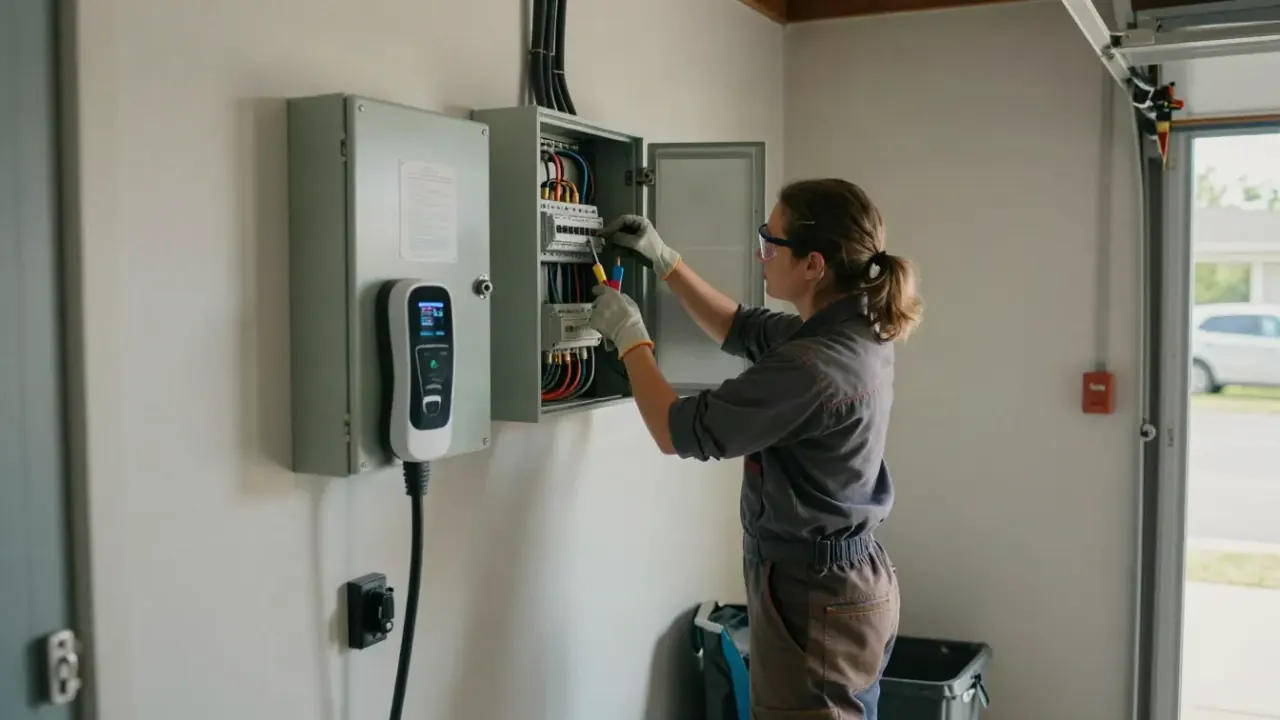
Indoor vs outdoor EV charger installation comes down to three things: weather exposure, wire distance, and where your panel sits. In Redondo Beach, an outdoor install is almost always possible - but it costs more, needs a NEMA 3R or 4 enclosure, and has to survive salt air, marine fog, and the occasional winter storm. An indoor install in your garage is cheaper, faster, and simpler, provided you actually have a garage and the panel can carry the load. This post walks through the real differences we see on jobs across the South Bay, from panel capacity to placement, so you can pick the right spot the first time.
What Actually Changes When You Move the Charger Outside
Moving a charger from a garage wall to a driveway post changes the enclosure rating, the wiring method, and the grounding path. Indoors, a standard NEMA 1 enclosure is fine. Outdoors, you need a NEMA 3R or NEMA 4 rated unit, GFCI protection on the circuit, and conductors rated for wet locations - usually THWN-2 in conduit rather than standard NM-B cable.
The distance also grows. A garage install might be a 15-foot run from the panel. An outdoor pedestal at the end of the driveway is often 40 to 70 feet, which means larger wire to fight voltage drop. On a 48-amp Level 2 charger, that is 6 AWG copper at minimum, sometimes 4 AWG.
And then there is the environment. Redondo Beach sits close enough to the water that salt-laden air corrodes cheap hardware in a couple of years. We spec marine-grade or stainless mounting hardware on every outdoor job for that reason.
Indoor vs Outdoor EV Charger Installation in Redondo Beach CA: The Core Differences
Indoor vs outdoor EV charger installation in Redondo Beach CA is a category of electrical work where the location decision drives the entire scope. Here is how the two stack up on the factors that actually matter.
- Enclosure rating: NEMA 1 indoors, NEMA 3R or 4 outdoors.
- Wiring method: NM-B cable indoors, THWN-2 in conduit outdoors.
- GFCI: Required on outdoor 240V receptacles per NEC 625.54; hardwired units vary.
- Run length: Typically 10-25 ft indoors, 30-80 ft outdoors.
- Permit and inspection: Required either way in Redondo Beach.
- Cost: Indoor runs run $850-$1,800; outdoor runs run $1,400-$3,200 in 2026.
If you already have a garage with a 240V feed nearby, indoor wins on cost and simplicity. If your only parking is a driveway or carport, outdoor is the only option - and it is a perfectly good one when it is done right.
Can I Install an EV Charger Outdoors in Redondo Beach?
Yes - outdoor EV charger installation in Redondo Beach is routine, and thousands of South Bay homes charge in driveways and carports every night. The catch is that the equipment and the wiring have to be rated for it.
We install outdoor units on pedestals, on exterior walls under eaves, and on freestanding posts near the parking pad. The three things that matter most:
- Mount above splash zone. Keep the charger at least 18 inches off the ground so rain runoff and sprinklers do not soak the connector.
- Use a weatherproof enclosure. NEMA 3R minimum; NEMA 4 if it is fully exposed to blowing rain.
- Seal every penetration. Conduit entries get weather-rated fittings, and we seal the wall penetration with exterior-grade caulk.
We also check the panel first. A 48-amp continuous load is 60 amps of breaker capacity, and plenty of Redondo Beach homes still have a 100-amp service. If yours does, we handle the Panel Capacity and Load Assessment Redondo Beach CA before we quote anything, and if the panel is maxed out we install a Subpanel Installation for EV Chargers Redondo Beach CA to free up capacity.
Do I Need a Weatherproof EV Charger in Redondo Beach?
You need a weatherproof EV charger in Redondo Beach if the unit will be mounted anywhere rain can reach it - which includes most carports and all driveway pedestals. Look for a NEMA 3R or NEMA 4 rating on the spec sheet. Most modern Level 2 units, including the Tesla Wall Connector, carry a NEMA 3R or better rating out of the box.
What people miss is the connector and the holster. The charging handle sits exposed for hours at a time, and salt air plus morning fog will pit cheap contacts. We recommend a holster with a cover and a quick wipe of the pins every few months.
If you want to schedule charging around off-peak rates or monitor usage remotely, we also handle Smart WiFi Charger Setup Redondo Beach CA so the unit connects reliably even at the far end of the property.
Best Location for an EV Charger at a Redondo Beach Home
The best location for an EV charger at a Redondo Beach home is the spot that keeps the cable run short, keeps the unit out of standing water, and puts the connector within reach of where you actually park. In practice, that is usually one of four places:
- Garage interior wall - cheapest, fastest, best if you park inside.
- Exterior wall under an eave - good protection, short run if the panel is on that side.
- Freestanding pedestal - best for long driveways and shared parking pads.
- Carport post - common in the older multi-unit buildings around the beach cities.
We see a lot of homes in South Redondo EV Charger Installation where the panel is on the street side and the parking is at the back, so the run crosses the whole house. In those cases a pedestal near the alley is often cheaper than trenching conduit through the yard.
For condos and shared buildings, the rules change again - you need HOA sign-off, a dedicated meter or submeter, and often a load-management system. We handle that whole process under Condo and HOA Charger Installation Redondo Beach CA.
Cost Differences: Indoor vs Outdoor Runs in 2026
Typical 2026 pricing in this area runs $850-$1,800 for an indoor Level 2 install and $1,400-$3,200 for an outdoor one, assuming the panel has capacity. The gap comes from three line items:
- Conduit and wet-rated wire - adds $4-$9 per foot over indoor cable.
- Weatherproof enclosure and pedestal - $150-$600 depending on the mount.
- Longer trenching or surface runs - $25-$60 per foot if we have to trench.
Panel upgrades, if needed, run $1,800-$3,500. A subpanel to free up capacity runs $900-$1,800. And if you want the cleanest possible install, a hardwired Level 2 Home Charger Installation Redondo Beach CA avoids the GFCI receptacle requirement that applies to NEMA 14-50 outlets outdoors.
Rebates can offset a chunk of this. LADWP and Southern California Edison both have EV charger programs, and the federal 30C tax credit still applies through 2030. We walk clients through the paperwork under Permit and Utility Rebate Help Redondo Beach CA.
Common Mistakes We See on Outdoor Installs
The mistakes we fix most often on outdoor jobs are predictable, and every one of them adds cost the second time around.
- Mounting too low. Anything under 18 inches gets soaked by sprinklers and rain splash.
- Using indoor-rated cable outside. NM-B degrades in UV and moisture. It has to be THWN-2 in conduit.
- Skipping the GFCI. Outdoor 240V receptacles require GFCI protection under NEC 625.54.
- Undersized wire. A 48-amp charger on 8 AWG will nuisance-trip and run hot.
- No drip loop. Water follows the cable straight into the enclosure without one.
- Ignoring the HOA. In condo buildings, unapproved installs get ripped out.
We also see plenty of DIY installs where the homeowner used a dryer outlet and a plug adapter. That works for about a week and then the breaker starts tripping. If your existing setup is misbehaving, our EV Charger Repair and Troubleshooting Redondo Beach CA team can usually diagnose it in one visit.
When to Call a Professional
Call a licensed electrician when the run crosses more than 25 feet, when the panel is older than 20 years, or when you are not sure the service can carry a 48-amp continuous load. Those three situations cover most of the tricky installs we see.
Redondo Beach EV Charger Installation handles both indoor and outdoor jobs across the beach cities. We pull the permit, run the load calculation, and mount the unit so it survives salt air and winter storms. If you want the job done once, we are the team to call.
Frequently Asked Questions
Can I install an EV charger outdoors in Redondo Beach?
Yes. Outdoor installs are routine here as long as the unit is NEMA 3R or 4 rated, the wiring is wet-rated THWN-2 in conduit, and the circuit has GFCI protection. Mount the charger at least 18 inches off the ground and seal every wall penetration.
What are the considerations for indoor vs outdoor EV charger installation in Redondo Beach CA?
The main ones are enclosure rating, wiring method, run length, GFCI requirements, and salt-air corrosion. Indoor installs run $850-$1,800; outdoor installs run $1,400-$3,200 in 2026. Panel capacity is the deciding factor in both cases.
Do I need a weatherproof EV charger in Redondo Beach?
If the charger is exposed to rain or fog, yes. Look for a NEMA 3R or NEMA 4 rating. Most modern Level 2 units, including the Tesla Wall Connector, already meet that spec - the connector and holster are what usually need extra protection.
How long does an outdoor EV charger installation take?
A straightforward outdoor install takes 4-6 hours. If we need to trench, add a subpanel, or run conduit more than 60 feet, plan on a full day or a two-day job. Permit turnaround in Redondo Beach is usually 1-2 weeks.
Does an outdoor charger need a dedicated circuit?
Yes. Every Level 2 charger needs a dedicated 240V circuit sized for the continuous load - 40 to 60 amps depending on the unit. Sharing a circuit with a dryer or range will trip breakers and is not code-compliant.
Get Help with EV Charger Installation in Redondo Beach
Whether you are mounting a charger in the garage or on a driveway pedestal, we handle the load calculation, the permit, and the install in one visit. Call Redondo Beach EV Charger Installation at (310) 294-5464 and we will tell you exactly which setup fits your home.